Tuesday, July 13, 2021

Year in Review: 2020


 I normally start these posts with a quick recap of the year in film, but 2020 really threw things for a loop. After the massive explosion of cinematic and superhero entertainment of 2019, the coronavirus pandemic slammed everything to a grinding halt the following year. Most movies were delayed for a whole year. Some were pushed directly to streaming services like Disney Plus or HBO Max. Theaters kept fluctuating between being closed or open at limited capacity. So, technically speaking, the highest grossing film of the year was the Japanese anime Demon Slayer. But does that really count? Nomadland won the Academy Award for Best Picture, but again, was that a fair competition?

There were three new superhero films in 2020. Marvel’s disastrous New Mutants was very quietly released after being stuck in development hell for years. DC’s Birds of Prey failed to garner much attention and Wonder Woman 1984 opted for an HBO Max release. That was the only of the three that had the potential to be a major blockbuster, and only the executives at Warner Brothers can determine if they made the financially prudent decision. I, for one, was happy to enjoy that movie from the comfort of my own home.

Of course, I’ve been burying the lead here. In 2020, I became a father! My wife gave birth to our son on March 20, just as all the shutdowns began (the hospital literally changed their rules for visitors while we were there). So, in light of all the challenges brought on by the pandemic, one silver lining was my ability to work from home and spend more time with my baby.

And luckily for us, the pandemic had a rather minimal effect on comic books. Apart from a brief hiatus at the beginning, DC continued to publish at a regular pace. And it was especially good for Impulse, since he became a regular in The Flash, as well as Young Justice. Granted, Young Justice took a major nosedive in 2020, ultimately leading to its cancellation in November, but that’s beside the point.

Best Story: The Flash #759

Brian Michael Bendis effectively held Impulse hostage for a full year, culminating in an empty, disappointing issue that focused entirely on Bart, but didn’t answer any questions or advance the plot in any way. Joshua Williamson finally reclaimed Bart and made the right decision in mostly ignoring whatever it was Bendis was trying, but failing to do. The Flash #759 unfortunately had a really stupid cover and not my favorite interior art, either, but the story was the best Impulse story we’ve had in years. I think the last time I was this excited was the debut of Bart in the Young Justice show way back in 2012. Williamson confirmed that Bart remembered being killed as the Flash, gave him an epic fight scene against the Reverse-Flash, and capped it all off with an emotional reunion with Grandma Iris. I couldn’t have asked for more in a single issue.

Best Writer: Joshua Williamson 

Williamson ended his Flash run on an unfortunately sour note by showing that the Reverse-Flash was single-handedly behind every mistake, argument and bad thing that ever happened to anyone in the Flash family. But everything up until that point was pretty good. And Bart’s explosive entrance into the story was more than enough for Williamson to earn this award for the third time. And, frankly, Bendis didn’t put up much of a competition. He got caught in the same pitfall of the Lost TV show, where the only thing he could do was allude to more mysteries and questions, but never answer them, trapped treading water until the series was mercifully taken from him.

Best Artist: John Timms

I was heartbroken when Patrick Gleason left Young Justice. Timms was nowhere near as brilliant, but a very serviceable replacement. Eventually, Timms left, too, and Scott Godlewski proved to be a serviceable replacement of Timms. But still, not quite as good, not nearly as dynamic as what we used to have. (Honestly, it mostly comes down to Timms drawing better Impulse hair than Godlewski.) The Flash books had a slew of artists, but none of them really got it done for me.

Best Supporting Character: Superboy

This is only the third time Superboy has won this award, as he’s almost always been the runner-up. But this year, he stood out head and shoulders above the rest. Part of that is due to Williamson’s failure to do anything meaningful with Impulse after that memorable entrance in issue #759. But part of it is also a credit to Bendis. (I know! I actually said something good about him!) As disappointing as Young Justice #16 was, I did appreciate how it showed that Superboy was hands-down Bart’s best friend on the team. Conner was the one Bart cared about the most and trusted the most. And more than anyone else in Bart’s life — including the Flash family — Conner had the ability to truly empathize with him. He’s the only one who has also experienced the trauma-inducing confusion of repeated deaths, rebirths and being stranded outside of his original reality.

Best Villain: Reverse-Flash

This is the first award for Eobard Thawne, although we have had other members of the Thawne family earn this honor — President Thaddeus Thawne and Inertia (who did reappear in 2020, but didn’t do anything). It’s true, I will never forgive the decision to blame Eobard on everything bad that ever happened to anyone in the Flash family (including keeping Bart away for a year). But I will credit him with orchestrating a large enough threat to warrant the inclusion of all our favorite speedsters. Taking over Barry Allen’s body and corrupting the Tornado Twins is a pretty big deal. Bart had to rescue both his father and his grandfather. And nothing remotely similar can be said about any of the “threats” from Young Justice. Seriously, Bendis, S.T.A.R. Labs is not evil!

Next time, we’ll begin 2021, which is odd because it’s currently July 2021 and I don’t know what the rest of the year holds. Sadly, I do know there are very few comic appearances, as the cancellation of Young Justice and the departure of Williamson has left DC without any creators who want to touch Impulse. But we will see a long overdue live-action version of Bart on the CW’s Flash. And the delayed fourth season of Young Justice is rumored to debut in October. It’s going to be strange catching up to real time on this blog. It all begins with Future State: The Flash #1.

Thursday, July 8, 2021

Dark Nights: Death Metal The Last 52: War of the Multiverses #1


Fight!

Joshua Williamson & Scott Snyder Writers
Dexter Soy pgs. 1-10 & Scott Koblish pgs. 75-80 Artists
Veronica Gandini Colorist
Tom Napolitano Letterer

Our cover by Dan Mora is a perfect reflection of the incomprehensible insanity of this story. Snyder just threw hundreds of characters into the pot to fight against hundreds more of corrupted versions of themselves. And they just fight and fight and fight. Not one bit of it makes any sense. And very little of this story — if you can even call it a story — appeals to me. Mainly because Impulse has not been involved at all. And this cover is a good reminder of that. Barry, Wally and Jay are present. But no Bart.

Bart does make a brief cameo in the main story of this issue, which focuses on Wonder Woman’s battle against The Batman Who Laughs. We briefly see Bart standing with Arrowette, who brags about bringing a lot of arrows to take down the approaching horde of evil Robins. But I think this glimpse of Impulse was a mistake, because we later see him make a “dramatic” entrance with the other speedsters who stayed behind in the Speed Force back in Speed Metal.


And that’s it. The long promised arrival of reinforcement speedsters was woefully underwhelming. And also besieged by editorial mistakes. Jay addresses Jesse, who wasn’t even speaking, and then specifically calls out Max and Avery, but not Bart. This is a level of sloppiness that is far beneath Joshua Williamson’s standards. In fact, if it weren’t for yet another diatribe about how awful Heroes in Crisis was, I’d suspect Williamson wasn’t involved at all. (Wally had to briefly confront an evil version of himself who was filled with bloodlust after killing all those people at the Sanctuary.)

I’m not mad at this story. Just disappointed. An army of speedsters is potentially the most powerful thing in the universe. But here, they were presented as nothing stronger than a couple of people with a bow and arrow. It’s a common problem with stories like this and try to involve everybody. The endless battle invariably reduces all characters to identical clones of each other who just fight and fight and fight, never doing anything unique or interesting.

The good news is we are now officially done with Dark Nights: Obnoxious Title. So let’s wrap up this post (and the year 2020) with some house ads:

DC Future State: The Next Batman. Hunted by the magistrate!
Dark Detective. The original Batman meets the next Batman!
Batman/Superman: The Dark Knight must save the Man of Steel from a powered-up Professor Pyg!

DC Future State: Superman: House of El. Being super runs in the family!
Superman of Metropolis. If these Kryptonians clash, nothing can save the city!
Superman: Worlds of War. It’s the main event: Superman versus Mongul!
Superman vs. Imperious Lex. Superman and Lois against the universe! Could the last days of Lexor be here already?!
Kara Zor-El: Superwoman. The Fortress of Solitude under siege!

Next time, we’ll hand out the awards for 2020, before jumping into Future State: The Flash #1.
Tuesday, June 29, 2021

Dark Nights: Death Metal The Secret Origin #1


Secret Origin

Scott Snyder and Geoff Johns Writers
Jerry Ordway (pp 1-7, 35-38) • Francis Manapul (pp 8-13, 32-34) • Ryan Benjamin & Richard Friend (pp 14-21) • Paul Pelletier & Norm Rapmund (pp 22-31) Artists
Hi-Fi (pp 1-7, 35-38) • Ian Herring (pp 8-13, 32-34) • Rain Beredo (pp 14-21) • Adriano Lucas (pp 22-31) Colorists
Rob Leigh Letterer
Ivan Regis, Joe Prado, & Alex Sinclair Cover
Gary Frank & Brad Anderson Variant Cover
Andrew Marino Editor
Superman created by Jerry Siegel with Joe Shuster. By special arrangement with the Jerry Siegel family.

Our cover shows Superboy-Prime battling The Batman Who Laughs (or as Prime calls him, The Batman Who Barfs).This is a solid, dynamic cover, bringing me back to the old Infinite Crisis days. It also answers the question of what to do when confronted by an impossibly invincible villain — you throw another impossibly invincible villain at him.

This story makes no sense, and it really doesn’t involve Impulse, so we’re not going to worry about it too much. Suffice it say, Superboy-Prime has been recruited to battle The Batman Who Laughs and the 52 evil worlds he has created. Prime is shunned by heroes and villains alike, especially our own Superboy, Conner Kent. Curiously, though, Krypto has taken a liking to this somber, reflective Superboy-Prime, even though Prime nearly killed the dog back in Infinite Crisis.

Anyway, The Batman Who Laughs actually seems kind of scared by Superboy-Prime and tries to cut him a deal, offering to give him his own world where he is accepted and loved as a hero. I’m not sure if The Batman plants this image in Prime’s head, or if it’s just Prime using his own imagination, but either way, we see a happy world that oddly includes the original Teen Titans, members of the Green Lantern Corps and our lovable Impulse.


But Superboy-Prime refuses the offer and ultimately destroys all the evil worlds created by The Batman Who Laughs. The effort of this fantastic feat kills Superboy-Prime, but he suddenly wakes up in his old bedroom, reading this very comic book. Unlike the last time he was sent back home and everybody knew all the horrific things he did, this world seems to have been reset to before Superboy-Prime’s crimes. His friends and family still love him, and he even still has his powers, making this the perfect paradise for this troubled character.


I like how Superboy-Prime’s vision of an ideal world shows him happily frolicking with the very heroes who imprisoned him during Infinite Crisis — first the Flash family, then the Green Lanterns. But I wish we could have had a reminder of how Superboy-Prime is terrified of Bart Allen. And I always wish that somebody at DC had the courage to tell the story of how Prime escaped the Speed Force and acquired the Anti-Monitor armor. But we’ll never get that. As for Superboy-Prime’s “redemption” — I’m not opposed to it, but I don’t think this issue was big enough to do justice to an event that monumental. Overlooking the insane incomprehensibleness of this Death Metal story, what we got in this issue was actually pretty nice — especially the Francis Manapul and Paul Pelletier art, as always.

Now for the new house ads:

DC Future State: Teen Titans. Meet the new Nightwing and his partner … Red X. 
The Flash. Can the fastest men alive outrun their destiny? (A version of Bart Allen will appear in this one.)
Legion of Super-Heroes. A Legionnaire betrays the entire galaxy!
Shazam! The power of Shazam corrupted and possessed by Raven!

DC Future State: Harley Quinn. She’ll have to secure her freedom and the future of Gotham!
Suicide Squad. Peacemaker goes to war with the Justice League!
Swamp Thing. He must wipe out humanity to save the planet.

Happy holidays from DC. Enjoy the season wherever you are in the multiverse!

Next time might be our final stop in the sprawling, obnoxiously titled Death Metal event. Unless Bart’s cameo is too small to be worth mentioning. In that case, we’ll skip ahead to Future State.

Tuesday, June 15, 2021

Dark Nights: Death Metal The Last Stories of the DC Universe #1


Together

Written by: Joshua Williamson, James Tynion IV, Scott Snyder
Art by: Travis Moore
Colors by: Tamra Bonvillain
Letters by: Andworld Design

Our cover by Tula Lotay with Dee Cunniffe is a bleak, rather ugly image of some of the most famous former Teen Titans surveying the wreckage of Dark Nights: Death Metal Obnoxious Title. Wally is dressed in his weird, blue Metron suit here, but he’s not in the inside story. That’s a tiny continuity complaint within a larger series (and company, frankly) that has turned its back on the very idea of a shared-universe continuity. How did all of our favorite characters get to this point from the last time we saw them? Nobody knows and nobody cares. Scott Snyder’s bloated “metal” story will not be diminished!

The main story of this comic bookends six separate stories about various heroes spending what may be their last day on Earth, in preparation of their final battle against the Batman Who Laughs. They’re all fairly forgettable vignettes, except for the Superman story told by Impulse creator Mark Waid and one of my favorite artists of all time, Francis Manapul. And that story is enough to justify the cost of picking up this comic. Impulse, however, is not involved in that story, but only the framework of the comic, so let’s get started.

We begin on what once was Themyscria, but now has become The Hellscape after the destruction caused by the Batman Who Laughs. Donna Troy is sitting on the beach feeling sorry for herself, until Beast Boy arrives and shows her that almost every former Teen Titan has gathered together for one last time. As Beast Boy and Donna work their way through the crowd, we’re given glimpses (reminders? memories?) of previous incarnations of the Teen Titans, including Bart Allen’s first stint as Kid Flash and the disastrous Bar Torr era of the New 52.


Wally West arrives fashionably late, and for a moment, everyone think Donna is going to fight him. But they just hug instead, while Bart awkwardly says that he should have told everyone he saw Wally before he left the Speed Force. But nobody responds to Bart because nobody cares — just as the three writers of this story don’t care about how Bart left the Speed Force or what happened to the rest of the Flash family. But we do get plenty of speeches on hope and perseverance (I’m looking at you, Joshua Williamson) before closing with a heroic shot of dozens of characters charging off to fight a vast, vague, nearly invincible force.


I guess the main point of this issue was simply to remind readers that all these characters used to exist and do things. Now, many of them do exist, but they’re not really doing anything. Like Arrowette, for example. She’s here, standing around silently, waiting for a giant action sequence that may or may not include her in the background of one or two massive group shots. We may as well be looking at statues in the Flash Museum.

I wish I felt something for this event. Back in the day, DC used to integrate their big events into the individual monthly titles. Even lame events like Genesis were reflected in the regular issues of Impulse. I wish Brian Michael Bendis’ Young Justice tied into this Death Metal nonsense. While investigating the major reality shift they all experienced, our heroes could have stumbled across this dumb, but significant continuity-altering crisis. At least that way, I would have actually been invested in this story, instead of merely saying, “Look, somebody drew Impulse in a comic book!” Let’s close with the new ads:

Future State: Wonder Woman. An Amazon warrior for a new age!

Future State: Superman of Metropolis. The son of Superman is the all-new Man of Steel!

DC Nation spotlight on Batman Black & White.

Next time: More Death Metal! Yay …

Tuesday, May 11, 2021

Young Justice #20


Final Justice

Brian Michael Bendis and David Walker Writers
Scott Godlewski Art
Gabe Eltaeb Colors
Wes Abbott Letters
John Timms and Gabe Eltaeb Cover
Derrick Chew Variant Cover
Bixie Mathieu Assistant Editor
Brittany Holzherr Editor
Jamie S. Rich Group Editor
Superboy created by Jerry Siegel.
By special arrangement with the Jerry Siegel family.

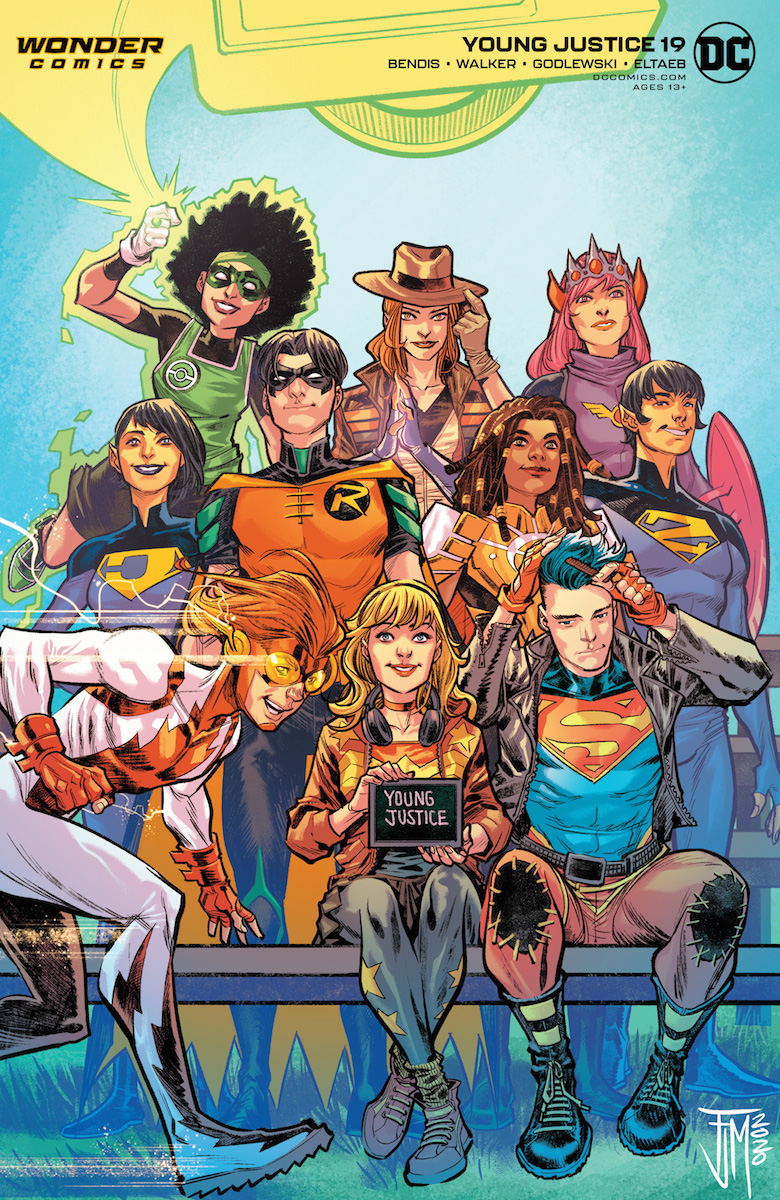
Our cover is a pretty nice, pretty standard pose of the entire team, including the Wonder Twins and Dial H for Hero kids, whom I guess would fall under the “part-time” status? Amethyst is also here right up front, pretending that she hasn’t been missing since issue #15. Naomi takes the spotlight, which makes sense, since she’s really the only character on this cover with a future (her own CW show). Everyone looks good, living up to John Timms’ standard. However, for the life of me, I have no idea why Teen Lantern has placed her green energy around Impulse. I also have to scoff a little at the promise of a “thrilling conclusion.”


Our variant cover (from dc.fandom.com) is an odd, moody collage that puts strange emotions on some of the characters. Why is Robin looming ominously over everyone? Why has Naomi turned her back on the team (other than to go star on the CW without them)? Why is Superboy not only front and center, but isolated from the group? And why is Impulse so small?!

Our story begins with a recap page that uses the same image I posted last issue of Poseidon attacking Wonder Girl and her friends, while Bart sneaks in a few more bites of his burger. Here’s the text that engages in only a small amount of revisionist history:

“Robin, Superboy, Impulse, Amethyst, Spoiler, Wonder Girl, Jinny Hex, Naomi, and Teen Lantern have come together with Dial H and the Wonder Twins as Young Justice!

“Young Justice took down the once great, but now evil, science corporation S.T.A.R. Labs, escaped a harrowing adventure through the multiverse, saved Gemworld from its evil oppressor, and teamed up with the Justice League to take down the Legion of Doom once and for all.

“In doing so, the entire group found out a lot of things about their past and their responsibilities to the future and each other.”

If that were a Wikipedia entry, I would have added several “citation needed” notes. But that’s OK. We know what really happened. And what is happening now in the story, is Teen Lantern courageously standing between an unseen assailant and her defeated teammates. To find out how we got here, we need to go back in time 33 minutes.

Robin, Superboy, Wonder Girl and Impulse have decided to take Naomi, Amethyst, Jinny Hex, Spoiler and Teen Lantern to Mount Justice, which Tim dubs as the “unofficial official headquarters of Young Justice.” He explains that technically, it’s a Justice League facility, but Young Justice is allowed to use it, as long as they clean up after themselves. This prompts Cassie to chastise Bart for leaving big messes around, but Bart blames Conner, calling him the “sloppiest Kent.” Conner calls Bart the most annoying speedster, who says “that is saying something,” before realizing he just burned himself.

Tim begins the tour, but Bart immediately dubs him boring. Conner shows off the fully stocked kitchen, but Bart thinks the gluten-free options are gross. Cassie begins to explain the purpose of the meeting room, but Bart points out that it’s self-explanatory. He begs to show off the secret water tunnel, connecting their pool to the ocean, but the new girls are more interested in the Red Tornado, who is oddly standing motionless under a light.

Bart proudly proclaims the Red Tornado to be the most sophisticated android in the entire multiverse. Jinny, perplexed, calls him the Red Tomato, but Teen Lantern is surprisingly a big fan. Robin and Superboy explain how Red was basically their babysitter, while Impulse wonders aloud why the android appears to be sleeping. Spoiler references the book “Do Androids Dream of Electric Sheep?”, which Bart claims to have not read, despite bragging about having traveled the entirety of the space-time continuum. (Either Bart is joking or he has forgotten that he did read the entire San Francisco Public Library back in the day.)

Bart points out that even if he was recharging, Red Tornado should have reacted to their presence by now. Of course, Bart seems even more surprised that Red has a huge fan in Keli. Bart jokes that it’s more understandable for the Blue Devil to have fans. He then touches Red Tornado, who immediately activates and attacks the group, calling them trespassers.

His initial blast knocked out Impulse, Amethyst and Jinny Hex. Superboy tries to order Red Tornado to stand down, but he mechanically orders the “intruders” to surrender before knocking out Conner and Cassie. Naomi takes a swing at him, but his knocked out, too. Robin and Spoiler coordinate a tag-team attack, but that doesn’t work, either.

And so that brings us back to the beginning, with Teen Lantern inexplicably the only hero left. And even more inexplicably, Teen Lantern completely dismantles Red Tornado in a single blast. Suddenly, John Stewart arrives, saying he should have confiscated Keli’s ring when he first saw her three days ago in what has now been titled the Battle of Shuster Park. Keli argues that she’s earned it, and the rest of Young Justice immediately wakes up to back her up. So John agrees to let her keep the Green Lantern ring, as long she repairs Red Tornado and meets with him at the Hall of Justice.

Robin, Superboy and Impulse then decide it’s time to call a “secret team meeting,” which turns out to be just hanging around a campfire outside the cave, along with Dial H and the Wonder Twins. And although the page says “Never the end!”, this is the end of this series.


What a waste. Such a disappointing end to a colossally disappointing series. I mean, why did we even come back to Mount Justice? Just to give Teen Lantern a little moment? Yeah, we saw Red Tornado, but he didn’t actually speak to the gang. Does he even remember them? We could have had some great callbacks to the original series. But no. Instead, we got ... nothing. Absolutely nothing. This issue was just a space filler. DC told Bendis he’d have to end at issue 20, and he clearly didn’t know what to do. So we got the laziest of references to the “good ol’ days,” and Amethyst was suddenly brought back as if she hadn’t been missing since issue 15. Oh, and let’s throw in Dial H for Hero and the Wonder Twins, too, just because. They all fell under Bendis’ strange Wonder Comics experiment that sadly fizzled out to the disappointment of all.

Dial H and Wonder Twins were wonderful comics. But they were never going to have a huge audience — especially with the (wrong) impression that they existed outside of mainstream DC continuity. This wasn’t true, but it seems like most of the creators at DC believed it to be true, as there was an incredible reluctance to use these characters in any other book. With Young Justice, that never should have been a problem. But it was. And, sadly, many of these characters will slide right back into obscurity.

This series started off with so much hope and promise. It was bright, bold, colorful and exciting. But then Patrick Gleason left, and Bendis began throwing more and more characters at us and more and more questions that would never be answered. I think it’s fair to say at this point that Bendis never was able to answer all the dozens of questions he brought up. Perhaps he felt he’d be able to figure things out eventually, but he never got around to it. It also seems like his knowledge of DC history and continuity was severely lacking. I suspect David Walker was brought in at the end to try to clean up Bendis’ mistakes. But there wasn’t much he could do.

Now we’re back to hoping and praying that someone will revive this series — or at the characters — and actually give them some room to breathe. In the meantime, let’s close with the new house ads:

Lobo stars in the most gratuitous tie-in of all! Dark Nights: Death Metal Infinite Hour Exxxtreme!

Get to know DC’s breakout character of 2020! Punchline #1. (Was she really a breakout character, or did DC just hype her up a lot?)

And we end with what may be the last DC Nation Spotlight on Teen Wonders.

Next time? Well, I’m not exactly sure. Bart allegedly made a few appearances in some of the Death Metal books. So we’ll see what I can find. Until then, keep praying for some good Impulse stories!

Tuesday, April 13, 2021

Young Justice #19


Gods and Monsters

Brian Michael Bendis and David Walker Writers
Scott Godlewski Art
Gabe Eltaeb Colors
Wes Abbott Letters
John Timms and Gabe Eltaeb Cover
Francis Manapul Variant Cover
Bixie Mathieu Assistant Editor
Brittany Holzherr Editor
Jamie S. Rich Group Editor
Superboy created by Jerry Siegel.
By special arrangement with the Jerry Siegel family.

Our cover shows Wonder Girl challenging Zeus ... even though he’s behind her ... while she’s wielding a golden lasso ... which she never has had in this series ... and standing on a Wonder Woman seal with a random broken column behind her. Timms is a great artist, but this is just a weird cover. Yeah, the energy and the emotion is right, and I guess that’s the most important thing. But the more I look at this cover, the odder it becomes.


Our variant cover is by one of my all-time favorites, Francis Manapul. And this is a delightful, light-hearted image of our team. Unfortunately, it does illustrate some of the main problems these variant cover artists have had with Young Justice. Nobody really knows who’s officially on the team (sorry Amethyst and Wonder Twins, you don’t belong here), and nobody really knows what Impulse’s costume is supposed to look like (although I will always advocate for the fingerless gloves).

Our story begins with a new recap page, presented as an Ancient Greek scroll beneath a picture of Zeus dramatically appearing before Cassie. Here’s what it says:

“Robin, Superboy, Impulse, Wonder Girl, Jinny Hex, Naomi, and Teen Lantern have come together and taken down the once great, but now evil science corporation S.T.A.R. Labs! (I’m convinced that David Walker wrote that line. There’s no way Bendis knew S.T.A.R. Labs was supposed to be good.)

“In doing so, the entire group found out a lot of things about their past and their responsibilities to the future and each other.

“On the road to finding herself, Cassie Sandsmark, a.k.a. Wonder Girl, has shaken off some of her responsibilities to the Pantheon.

“Her grandfather Zeus is not pleased.”

What follows next is a rather sloppy attempt at condensing what must have been a planned six-issue story into just one issue. So let’s just skip ahead to Wonder Girl meeting up with Young Justice at an outdoor cafe in Central City. Last issue didn’t indicate that the team went to Central City to celebrate Spoiler’s victory over Cluemaster and Tim’s decision to become Robin again. Last issue also clearly showed that Wonder Girl was forcefully blasted over to her teammates, creating a small crater in the road when she landed. But this issue showed she calmly flew over there under her own power, after having defeated a random large monster.

Cassie orders a hamburger and tells her team that she’s the granddaughter of Zeus, who wants her to join the Pantheon of Gods. But nobody understands why this has Cassie so upset. Bart even jokes that he’s known Cassie for 79 years and he still doesn’t get it. Cassie tries to explain herself, only lamely coming up with “Zeus makes no sense to me. I don’t get it. Does that make any sense?” Her friends are supportive, but they do have follow-up questions about the exact nature of being in the Pantheon. Before Cassie can contemplate this subject that she seems to know nothing about, Bart notices a large oceanic event heading their way ... even though they’re in Central City.


Turns out it’s Poseidon, who was just messing with Zeus. Young Justice quickly defeat Poseidon and his sea monsters on a single splash page, thanks mostly to the magic sword Zeus gave Cassie. Yeah, since Amethyst is gone, I guess we needed another girl with a magic sword. Anyway, Zeus shows up to congratulate Cassie and again offer her a spot on the Pantheon. She refuses him once more — for no reason — and when Zeus threatens her with banishment, Wonder Girl and Young Justice strike a dramatic fighting pose. But Zeus just says, “So be it,” and teleports away in a flash of lightning. Wonder Girl looks up to the sky and smiles, as a single tear runs down her cheek.


In the movie Space Balls, an exasperated priest is trying to conduct a wedding ceremony, but keeps getting interrupted. Ultimately, he delivers what he calls the “short short version.” This is the short short version of Bendis’ Wonder Girl story. And it’s a shame, since Wonder Girl has always been shorted by DC. Unlike Robin, Superboy and Impulse, Wonder Girl never had her own monthly series beyond a couple of specials and limited-issue runs. And here, with everything crammed together so quickly and forcefully, the story loses all the impact it could have had. We never understand what being in the Pantheon actually means or why Cassie refuses to join it. The magic sword completely came out of nowhere, as well as Poseidon’s involvement. 

Frankly, this issue never should have been attempted. With the series ending at issue 20, #19 should have focused on setting up a satisfying ending. This Wonder Girl story should have been fleshed out in a separate 6-issue miniseries — if Bendis could have used his clout to launch yet another miniseries. Barring that, he could have at least given his outline to the Wonder Woman team and begged them to tell his story. As such, we were left with yet another disappointing issue leading to the conclusion of this short-lived, disappointing series.

Here are the new house ads:

The darkest night rises. The multiverse falls. History will be rewritten. Dark Nights: Death Metal Rise of the New God.

The most sadistic 10-year-old in existence! Dark Nights: Death Metal Robin King.

DC Nation spotlight on teen wonders.

Next: Final Justice.

Thursday, April 1, 2021

Dark Nights: Death Metal Speed Metal #1


Speed Metal

Joshua Williamson Writer
Eddy Barrows Penciller
Eber Ferreira Inker
Adriano Lucas Colorist
Steve Wands Letterer
Barrows, Ferreira, Lucas Cover
Peach Momoko Variant Cover
Andrew Marino Editor
Marie Javins Executive Editor

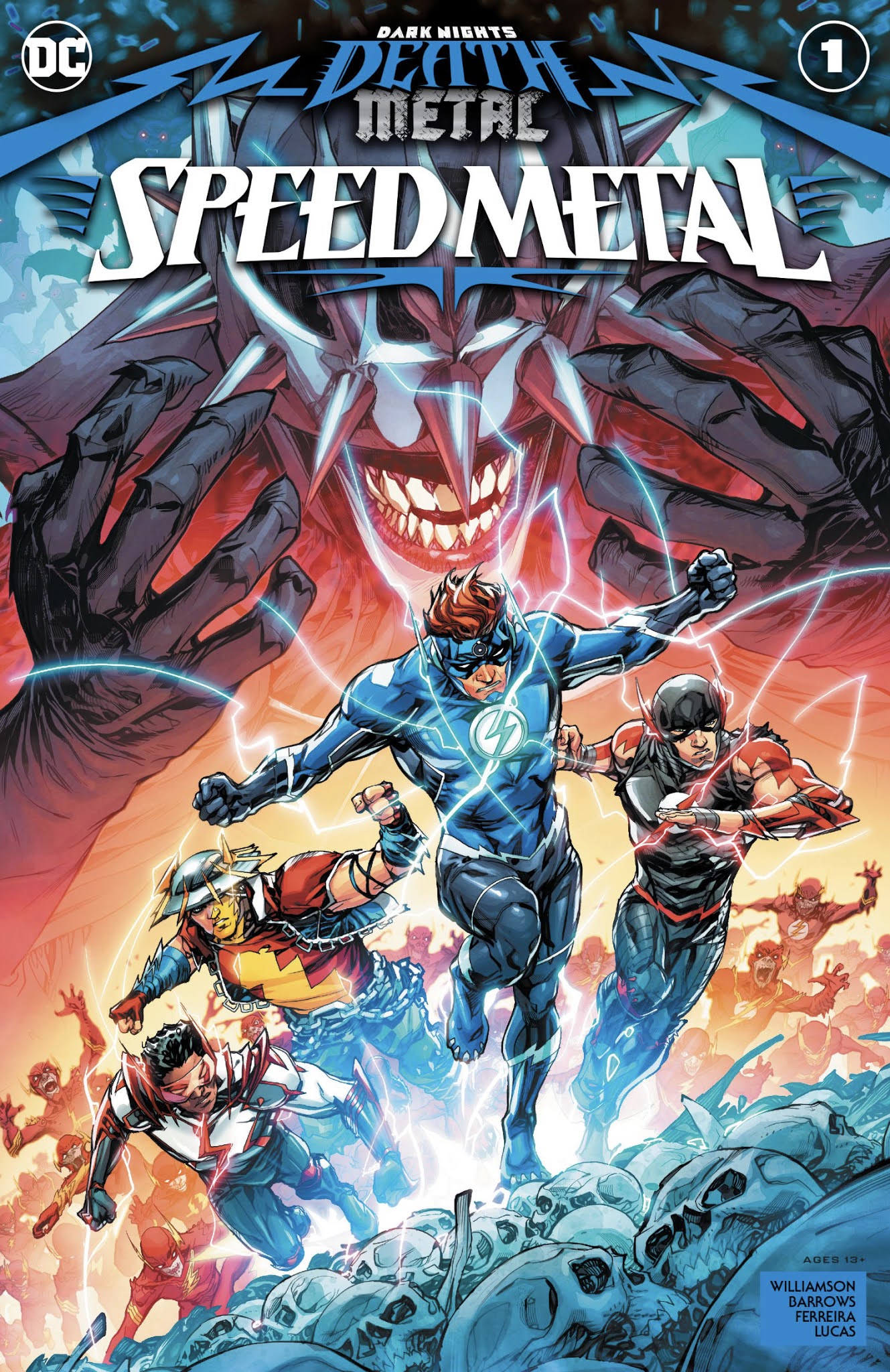
Our cover shows Wally in his new blue, Mobius Chair costume, leading Barry, Jay and Wallace (all in stupid “metal” costumes) across a field of skulls, away from a horde of zombie Flashes and the enormous, all-powerful Batman Who Laughs. It is all incredibly stupid. And I’m not just saying that because Impulse was left out. The whole concept of this bloated event is utterly ridiculous and bizarre. The story itself is as strange and clunky as its name — an obnoxious clunkiness that becomes even worse in tie-in issues like this. No comic should have three titles. Two is understandable. But three is too much.

It feels like this story should take place outside of continuity — in an Elseworlds setting like DCeased. But it’s not. Apparently, shortly after Barry defeated the Reverse-Flash and hosted that triumphant backyard barbecue, the Batman Who Laughs transformed into an all-powerful enormous entity that has consumed the entire world and is chasing our heroes around just like on the cover.

After running around for a bit, Wally freezes time by using Johnny Quick’s old formula, which gives our speedsters time to visit the destroyed Flash Museum and talk about legacy and their feelings. Wally suggests they stop running away from the horde of Dark Flashes and instead run through them. Barry and the others agree, but Jay succumbs to exhaustion first, followed by Wallace. Barry then chooses to give all his speed to Wally, which gives him enough energy to take the Mobius Chair away from the Batman Who Laughs and into the Speed Force.

To Wally’s surprise, he finds his family and friends waiting for him in the Speed Force. Barry, Wallace and Jay are there, in addition to Linda, Jai, Irey, Avery, Iris, Jesse, Max, and, of course, our lovable Bart. And apparently it was Bart’s idea to take everybody to the Speed Force, as he remembered the time Abra Kadabra sent Wally there way back when.


However, Bart’s reunion with Wally is a bit subdued, as he merely says, “Sup, old man.” But it’s not like there’s time for lengthy reunions, anyway. Wally says it’s only a matter of time before the Batman Who Laughs reaches them in the Speed Force, so he recruits Barry and Jay to help him deliver the Mobius Chair to Wonder Woman, telling all the others to join them when the time is right. Bart promises to bail Wally out again, and with that, the first three Flashes race off into the rest of the Death Metal storyline.


I really don’t understand what was the point of this comic book. The most interesting parts — Barry finding Wally and Bart pulling everyone into the Speed Force — happened off page. Maybe if Williamson didn’t spend so much time on his “inspiring” heart-to-heart conversations we could have actually seen Bart organizing a dangerous, last-second escape. Of course, such a story would have been rather repetitive after that DCeased issue. So that just brings me back to my original point. Did we really need this comic? Did anything substantial actually happen? Why bother drawing all those dark/zombie Flashes if they weren’t going to actually do anything? Why give those characters different “metal” costumes if it had no bearing on the plot? I guess that’s why I don’t like this event. Nothing really matters, and as the reader, I’m just supposed to sit back and marvel at how “cool” and “metal” everything is. But that’s not me.

Next time, we’ll examine the penultimate issue of Bendis’ Young Justice.